Key takeaways
- The kettlebell thruster combines a front squat and overhead press into one continuous movement, driven by hip extension.
- It builds lower-body strength, shoulder stability, and work capacity in a single exercise.
- Load selection matters: start 2–3 sizes lighter than your single-arm overhead press max.
- Common faults include pausing at the bottom, pressing before full hip extension, and losing rack position during the squat.
- Thrusters work for both strength blocks (lower reps, heavier load) and conditioning circuits (higher reps, moderate load).
- Single-arm and double-kettlebell variations offer different stimulus and scaling options.
Who this is for
The kettlebell thruster suits intermediate and advanced trainees who are comfortable with front squats, overhead presses, and the rack position. Beginners should master those component movements first before combining them. It works well for home gym training, CrossFit-style conditioning, and strength-and-conditioning programs. It is not appropriate for people with acute shoulder, elbow, or knee pain; consult a healthcare provider if you have movement restrictions. This guide is educational only and does not replace professional medical or coaching advice.
Movement definition
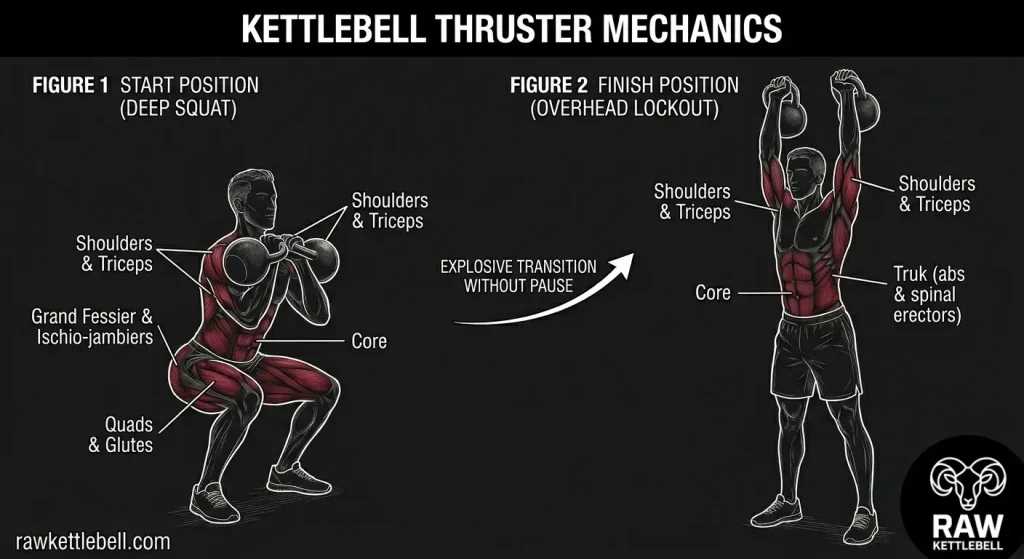
The kettlebell thruster is a compound, full-body movement that combines a front squat and an overhead press into one fluid rep. You begin with the kettlebell(s) in the rack position at shoulder height, descend into a front squat, then explosively extend the hips and legs to drive the kettlebell overhead. The press is powered by the lower body, not the arms alone. The movement is continuous—no pause at the bottom—and ends with the kettlebell locked out overhead, arm(s) extended, and core braced.
Thrusters are used for strength development, power training, and metabolic conditioning. They demand coordination, mobility, and stability across multiple joints. Single-arm thrusters add a rotational stability challenge; double-kettlebell thrusters allow heavier loading and symmetric strength development.
Start position and setup
Stance and foot placement:
– Stand with feet shoulder-width apart, toes slightly turned out (5–10 degrees).
– Weight distributed evenly across the mid-foot and heel.
– Engage your core and maintain neutral spine.
Rack position:
– Kettlebell(s) rest on the forearm, cradled between the bicep and the chest.
– Elbow(s) tucked close to the ribcage (not flared out).
– Wrist neutral or slightly extended; kettlebell handle sits in the palm, not the fingers.
– Shoulder packed: scapula slightly retracted, shoulder joint stable.
– For double kettlebells, both bells sit symmetrically in the rack position.
Breathing setup:
– Take a breath into the belly before descending.
– Brace the core as if preparing for a punch.
Execution checkpoints
-
Descent (front squat phase):
– Initiate the squat by breaking at the hips and knees simultaneously.
– Keep the kettlebell(s) in the rack position; do not let them drift forward or backward.
– Descend to a depth where the hip crease is level with or slightly below the knee, or as far as mobility allows.
– Maintain an upright torso; avoid excessive forward lean.
– Knees track over toes; do not cave inward. -
Transition (bottom position):
– Reach the bottom of the squat in a controlled manner.
– Do not pause; immediately begin the ascent.
– Maintain bracing and core tension. -
Ascent and press (power phase):
– Drive through the mid-foot and heels to extend the hips and knees explosively.
– As the hips extend, use that momentum to press the kettlebell(s) overhead.
– The press is powered by the lower body; the arms guide and lock out the weight.
– Extend the arm(s) fully overhead, elbow(s) locked.
– Finish with the kettlebell(s) directly over the shoulder joint, not forward or behind.
– Core remains braced; avoid excessive lumbar extension or arching. -
Lockout position:
– Kettlebell(s) overhead, arm(s) fully extended.
– Shoulder packed and stable.
– Wrist neutral or slightly extended.
– Brief pause (1–2 seconds) to confirm stability, then lower back to the rack position and repeat.
Breathing and bracing
- Inhalation: Breathe in during the descent into the squat.
- Exhalation: Exhale forcefully as you drive up and press overhead. Some athletes exhale on the ascent; others exhale at lockout. Choose one and stay consistent.
- Bracing: Engage the core before each rep. Imagine bracing for a punch to the stomach. Maintain tension through the squat and press.
- Multiple reps: For sets of 3–5 reps, you may breathe at the top (lockout position) before lowering. For higher reps, breathing patterns may shift slightly, but maintain core tension throughout.
Fixation and finish standards
- Lockout: Arm(s) fully extended, kettlebell(s) directly over the shoulder joint.
- Stability: No wobbling or shifting of the kettlebell(s) at the top.
- Posture: Upright torso, neutral spine, no excessive lumbar extension.
- Duration: Hold the lockout for 1–2 seconds to confirm control before lowering.
- Descent: Lower the kettlebell(s) back to the rack position under control; do not drop or collapse.
Common faults and corrections
| Fault | Cause | Correction |
|---|---|---|
| Pausing at the bottom of the squat | Misunderstanding the movement as two separate lifts | Emphasize continuity: squat and press flow together. Practice the movement at a slower tempo to build the pattern. |
| Pressing before full hip extension | Weak hip drive or impatience | Cue: “Squat first, then press.” Use lighter load and focus on explosive hip extension before the arms engage. |
| Losing rack position during descent | Elbows flaring or kettlebell drifting forward | Keep elbows tucked and kettlebell close to the body. Practice front squats alone to reinforce rack position. |
| Excessive forward lean in the squat | Weak ankle mobility or poor posture | Improve ankle and hip mobility. Elevate heels slightly (on a small plate) if needed. Cue upright torso. |
| Pressing the kettlebell forward (not directly overhead) | Weak shoulder stability or poor lockout position | Practice overhead presses from standing to build shoulder stability. Ensure the kettlebell finishes directly over the shoulder, not in front. |
| Collapsing at the bottom (no rebound) | Load too heavy or fatigue | Reduce load by 1–2 sizes. Ensure adequate rest between sets. Focus on explosive hip extension. |
| Uneven loading (single-arm thruster) | Core weakness or asymmetric strength | Reduce load. Perform extra single-arm work on the weaker side. Strengthen anti-rotation core work (pallof presses, suitcase carries). |
Regressions and progressions
Regressions (if you struggle with the full thruster):
- Kettlebell front squat: Master the squat alone in the rack position. Build lower-body strength and rack position comfort.
- Kettlebell overhead press (standing): Develop shoulder stability and pressing strength from standing.
- Kettlebell push press: Squat slightly and use hip drive to press, but without a full squat. Bridges the gap between front squat and thruster.
- Goblet squat to press: Hold a kettlebell by the horns at chest height, squat, then press overhead. Reduces load and improves the movement pattern.
Progressions (once the basic thruster is solid):
- Increase load: Add 4–8 kg to your working kettlebell(s).
- Double kettlebell thrusters: Progress from single-arm to both arms, doubling the load and demand.
- Higher reps: Move from 3–5 reps per set to 8–12 reps for conditioning and work capacity.
- Tempo variations: Slow the descent (3–4 seconds), pause at the bottom (1–2 seconds), or accelerate the press for power.
- Thruster complexes: Combine thrusters with other movements (e.g., thruster + front squat, thruster + overhead press) in a single set.
- Single-leg thruster: Advance to a pistol squat thruster or split-squat thruster for unilateral strength and stability.
Load and implement selection
Kettlebell size:
– Beginners to the thruster: Start 2–3 sizes lighter than your single-arm overhead press max. For example, if you press a 24 kg bell, begin thrusters with a 16 kg.
– Strength focus: Use 70–85% of your single-rep max for 3–5 reps per set.
– Conditioning focus: Use 50–65% of your single-rep max for 8–15 reps per set.
– Double kettlebells: Typically 1–2 sizes lighter per hand than single-arm work, since the total load is doubled.
Single vs. double kettlebells:
– Single-arm: Builds unilateral strength, improves anti-rotation core stability, and is easier to scale for beginners.
– Double kettlebells: Allows heavier loading, demands symmetric strength, and is excellent for strength-focused blocks.
Implement notes:
– Kettlebells with a smooth handle and balanced weight distribution are ideal.
– Ensure the kettlebell fits comfortably in your hand and forearm during the rack position.
Program placement
Strength blocks (3–6 weeks):
– 3–4 sets of 3–5 reps per arm or set.
– Rest 2–3 minutes between sets.
– Use heavier load (70–85% of max).
– Pair with lower-body or upper-body accessory work.
Conditioning and work capacity blocks (4–8 weeks):
– 3–5 sets of 8–12 reps per arm or set.
– Rest 45–90 seconds between sets.
– Use moderate load (50–65% of max).
– Combine with other movements in circuits or complexes.
Mixed training (strength + conditioning):
– Use thrusters 1–2 times per week.
– Alternate between strength days (lower reps, heavier load) and conditioning days (higher reps, moderate load).
– Avoid excessive frequency; allow 48 hours recovery between thruster sessions.
Sample placements:
– Main lift in a strength session (after a warm-up and mobility work).
– Finisher in a conditioning circuit (e.g., 10 min AMRAP: 5 thrusters + 10 kettlebell swings).
– Part of a complex (e.g., clean + front squat + thruster).
Related movements
- Kettlebell front squat: The lower-body component of the thruster; build squat strength and rack position comfort here.
- Kettlebell overhead press: The upper-body component; develop shoulder stability and pressing strength.
- Kettlebell push press: A hybrid movement using hip drive to assist the press; lighter than a thruster, heavier than a strict press.
- Kettlebell clean: The entry movement into the rack position; essential for thruster training.
- Kettlebell goblet squat: A regression or accessory movement for squat depth and lower-body strength.
- Kettlebell snatch: A ballistic, single-arm movement; complements thruster training for power and conditioning.
- Kettlebell swing: A foundational hip-hinge movement; builds posterior chain power that supports thruster performance.
- Double kettlebell front squat: Builds symmetric lower-body strength for double-kettlebell thrusters.
FAQ
What’s the difference between a kettlebell thruster and a barbell thruster?
The kettlebell thruster uses a single or double kettlebell in the rack position, allowing greater freedom of movement in the wrist and elbow. The barbell version locks the arms into a fixed width. Kettlebell thrusters are easier to load asymmetrically (one arm) and scale down for beginners. Both develop similar power and conditioning benefits, but kettlebell thrusters suit home gyms and mixed training better.
Can I do a kettlebell thruster with two kettlebells?
Yes. Double kettlebell thrusters are common and allow heavier loading than single-arm work. They demand more core stability and symmetric strength. Start with lighter bells to master the movement, then progress load. Double thrusters are excellent for strength-focused blocks and conditioning circuits.
How heavy should my kettlebell be for thrusters?
Start 2–3 sizes lighter than your single-arm overhead press max. A typical progression: 16 kg for women, 24 kg for men, then advance by 4–8 kg as form solidifies. For conditioning circuits, use 40–60% of your single-rep max to maintain movement quality across sets and reps.
Should I pause at the bottom of the squat in a thruster?
No. The thruster is a continuous movement—squat and press flow together without a pause. Pausing breaks momentum and increases fatigue unnecessarily. The transition from squat to press should be smooth and driven by hip extension, not a dead stop.
Can I use kettlebell thrusters for conditioning, or are they only for strength?
Both. Thrusters are excellent for conditioning circuits and metabolic work. Use moderate loads (50–65% of max) for higher reps (8–15 per arm or set) and shorter rest periods. They build work capacity, cardiovascular fitness, and muscular endurance alongside strength.
What if I can’t press the kettlebell overhead from the squat position?
You likely need to regress. Start with kettlebell front squats alone, then add overhead presses from standing. Once both movements are solid, combine them. Alternatively, reduce load or practice the rack position mobility to improve shoulder and thoracic extension.