Key takeaways
- The Get Up Shin Box Knee Hand is a kneeling-to-half-kneeling transition drill that isolates core stability and shoulder control.
- It serves as both a regression for the full Turkish get up and a standalone mobility/stability tool.
- Start with light load (8–12 kg) or bodyweight; the focus is positioning and control, not strength.
- Use it 2–4 times per week in warm-ups or skill sessions, keeping reps low (3–5 per side).
- Common faults include collapsing the torso, losing shoulder tension, and poor knee positioning during the transition.
- Progress to the half-kneeling get up or full Turkish get up once you own the movement pattern and can maintain overhead stability.
Movement definition
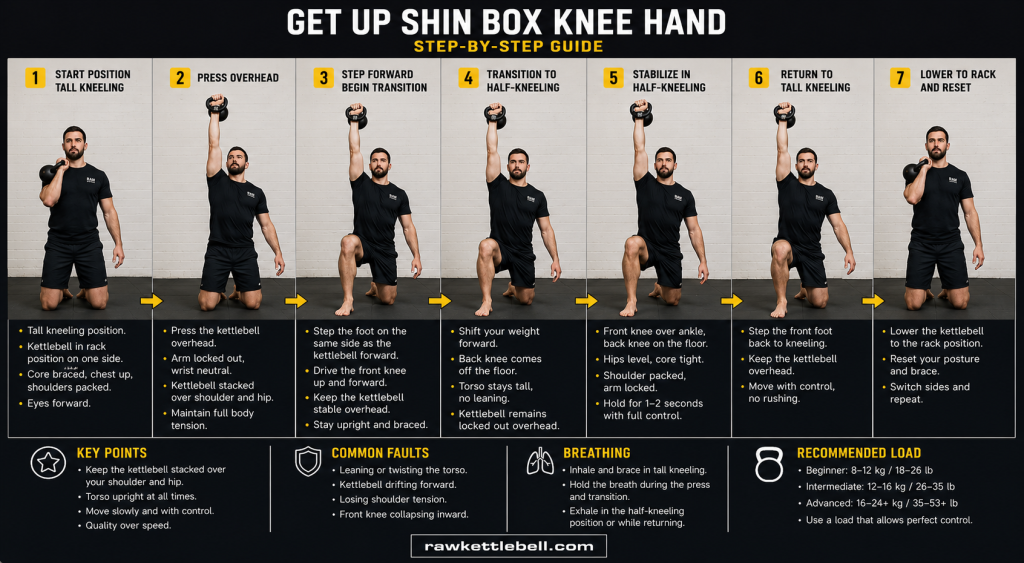
The Get Up Shin Box Knee Hand is a kneeling kettlebell variation that isolates the transition from a tall kneeling position (both knees on the ground) to a half-kneeling position (one knee up, one knee down) while maintaining an overhead kettlebell position. The movement emphasizes core bracing, shoulder stability, and controlled weight transfer through the lower body. It is not a full get up; it is a segmented drill that removes the supine and seated phases, allowing you to focus entirely on the kneeling mechanics and overhead control.
Who this is for
Best suited for:
– People learning the Turkish get up who need to isolate the kneeling-to-half-kneeling transition.
– Lifters building overhead shoulder stability and core control in a reduced-complexity environment.
– Anyone warming up before pressing or get up work.
– Individuals working through mobility limitations in the hips, knees, or shoulders.
Not recommended for:
– People with acute knee pain or injury; consult a healthcare provider first.
– Those with significant shoulder impingement or instability; regress to bodyweight or lighter load.
– Lifters who have not yet learned basic kettlebell positioning (rack position, bracing).
Start position & setup
- Kneeling base: Kneel on a padded surface (yoga mat, folded towel, or dedicated kneeling pad). Both knees are on the ground, hip-width apart. Shins are vertical or slightly angled forward; avoid excessive shin angle that loads the front of the knee.
- Torso posture: Sit upright with a neutral spine. Shoulders are packed (scapulae retracted and depressed). Core is braced as if preparing for a punch to the stomach.
- Kettlebell position: Hold the kettlebell in the rack position on one side (e.g., right side). The bell sits in the crook of your elbow, forearm vertical, wrist neutral. The handle is at roughly collarbone height.
- Free arm: The non-bell arm hangs at your side or rests lightly on your thigh for balance. Some lifters place the free hand on the ground in front for additional stability during the transition.
- Head and gaze: Eyes forward, neutral neck position. Avoid looking down or excessively up.
Execution checkpoints
Phase 1: Establish overhead position
– Press the kettlebell overhead using a smooth, controlled motion. The bell should track in a straight vertical line.
– Lock out the arm fully. The kettlebell sits directly over your shoulder and hip (not forward or back).
– Maintain core tension and shoulder packing throughout.
– Checkpoint: Your overhead arm is vertical, wrist is neutral, and the bell feels stable and centered.
Phase 2: Transition to half-kneeling
– From tall kneeling with the kettlebell overhead, step one foot forward (the foot on the same side as the kettlebell).
– The stepping knee drives forward and up; the heel of the back knee lifts off the ground as you shift weight forward.
– Keep the kettlebell locked overhead and your torso upright. Do not lean or collapse forward.
– Checkpoint: You are now in a half-kneeling position (one knee down, one knee up) with the kettlebell stable overhead.
Phase 3: Stabilize and finish
– Settle into the half-kneeling position. The front knee is directly over the ankle; the back knee is on the ground.
– Press your hips forward slightly to achieve a tall, stable half-kneeling posture.
– Hold the overhead position for 1–2 seconds, maintaining full body tension.
– Checkpoint: The kettlebell is locked, your torso is upright, and you feel stable and balanced.
Phase 4: Return to tall kneeling
– Step the front foot back to return to tall kneeling, or simply lower the back knee to the ground.
– Lower the kettlebell to the rack position in a controlled manner.
– Reset and repeat on the opposite side.
Breathing & bracing
- Inhale as you settle into the tall kneeling position and establish your initial brace.
- Hold that breath and tension as you press the kettlebell overhead.
- Maintain bracing through the transition to half-kneeling. This is a short movement; a single breath hold of 3–5 seconds is appropriate.
- Exhale as you stabilize in the half-kneeling finish position, or exhale as you lower the bell back to rack.
- Do not over-hold your breath; this is a technical drill, not a max-effort lift. Breathing should feel natural and controlled.
Fixation & finish standards
- The kettlebell is locked overhead with a fully extended arm.
- The shoulder is packed (scapula retracted and depressed); no shrugging or instability.
- The torso is upright and braced; no excessive lean, rotation, or side-bend.
- The half-kneeling position is stable: front knee over ankle, back knee on the ground, hips level.
- You can hold the finish position for 1–2 seconds without loss of tension or balance.
- The movement is performed with equal quality and control on both sides.
Common faults & corrections
| Fault | Cause | Correction |
|---|---|---|
| Torso collapses or leans forward during transition | Weak core brace or loss of focus on upright posture | Reduce load; practice tall kneeling holds with kettlebell overhead before adding the transition. Cue: “Stay tall, chest up.” |
| Kettlebell drifts forward or backward overhead | Shoulder not packed; arm not vertical | Reset the rack position. Press straight up. Use a lighter bell to reinforce vertical path. |
| Back knee slides or doesn’t stay planted | Poor hip stability or weak glute engagement | Reduce stepping distance. Press hips forward in half-kneeling. Cue: “Squeeze your glute.” |
| Excessive shin angle or knee pain | Poor kneeling setup or padding inadequate | Use a thicker pad. Adjust shin angle to be more vertical. If pain persists, consult a healthcare provider. |
| Unequal performance left vs. right | Asymmetry in mobility or strength | Perform extra reps on the weaker side. Identify whether the limitation is mobility (hip, shoulder) or stability (core, glute). |
| Head drifts or gaze shifts | Loss of focus or balance compensation | Keep eyes forward. Maintain neutral neck. Use a fixed point to gaze at. |
Regressions & progressions
Regressions:
– Bodyweight shin box knee hand: Perform the movement without a kettlebell. Hands can be clasped overhead or one arm extended. This removes load and allows you to focus purely on the kneeling transition and balance.
– Tall kneeling kettlebell hold: Hold the kettlebell overhead in tall kneeling without the transition. Build shoulder stability and core bracing in isolation.
– Half-kneeling kettlebell hold: Start in half-kneeling and simply hold the kettlebell overhead. Remove the dynamic transition element.
Progressions:
– Half-kneeling get up: Begin from a seated or supine position and progress through the full sequence of movements to half-kneeling, then standing. This adds complexity and range of motion.
– Turkish get up (full): Progress to the complete Turkish get up, which includes the supine, seated, and kneeling phases before standing.
– Loaded half-kneeling press: From a half-kneeling position, perform multiple kettlebell presses. This builds pressing strength and stability in the half-kneeling posture.
– Get up to standing: After the half-kneeling position, stand up while maintaining the kettlebell overhead. This adds a lower-body strength component.
Load & implement selection
Kettlebell weight:
– Beginners or first attempt: 8–12 kg (18–26 lbs). Light load allows you to focus on movement quality and positioning.
– Intermediate: 12–16 kg (26–35 lbs). Increase load once you own the pattern and can maintain stable overhead position.
– Advanced: 16–24 kg (35–53 lbs) or heavier, depending on your full get up working weight. Many lifters use 50–70% of their full get up weight for this drill.
Implement options:
– Single kettlebell (standard): The most common choice. Provides unilateral loading and challenges core stability.
– Bodyweight: Excellent for learning and warm-ups. No external load to manage.
– Dumbbell: Can be used if kettlebells are unavailable, though the handle position differs slightly.
Padding:
– Use a yoga mat, folded towel, or dedicated kneeling pad to reduce pressure on the knees. This is not optional; proper padding protects your knees and allows you to focus on the movement.
Program placement
Warm-up or mobility block (2–4 times per week):
– Perform 3–5 reps per side with light load or bodyweight.
– Use it to prepare for Turkish get up work, pressing, or half-kneeling exercises.
– Helps identify asymmetries or mobility limitations before heavier work.
Skill or technique session:
– Dedicate 5–10 minutes to this drill as part of a dedicated movement practice.
– Perform 3–5 sets of 3–5 reps per side, focusing entirely on quality.
– Pair with related movements (e.g., tall kneeling holds, half-kneeling presses).
Not a conditioning or high-volume tool:
– This is a technical drill, not a metabolic or strength-building exercise.
– Keep total reps per session low (15–25 reps per side per week).
– Avoid using it as a finisher or high-rep conditioning movement.
Related movements
- Turkish get up (full): The complete progression; includes supine, seated, and kneeling phases.
- Half-kneeling get up: Begins from seated or supine and progresses to half-kneeling and standing.
- Tall kneeling kettlebell press: Builds overhead pressing strength and stability from a kneeling base.
- Half-kneeling kettlebell press: Pressing from a half-kneeling position; isolates core and shoulder stability.
- Kettlebell windmill: A different overhead stability drill that challenges rotation and lateral stability.
- Bottoms-up kettlebell carry: Builds shoulder stability and proprioception in a standing position.
- Half-kneeling Pallof press: Anti-rotation core drill that complements get up work.
FAQ
Is the Get Up Shin Box Knee Hand a regression or a standalone drill?
It is both. It serves as a regression for people learning the full Turkish get up, isolating the kneeling-to-half-kneeling transition and shoulder control. It also works as a standalone core and stability drill in warm-ups or mobility sessions. Use it to diagnose asymmetries or build confidence with overhead positioning before progressing to the full movement.
What load should I use for this variation?
Start with a light kettlebell (8–12 kg for most adults) or even bodyweight. The focus is positioning and control, not load. Once you own the movement pattern with a light bell, you can increase incrementally. Many people use this as a warm-up or drill with 50–60% of their full get up working weight.
How does breathing work during the shin box knee hand?
Inhale as you settle into the shin box position and establish your brace. Hold that tension through the transition to half-kneeling. Exhale as you stabilize overhead in the finish position. Avoid breath-holding for more than 3–5 seconds; this is a technical drill, not a max-effort lift.
Can I do this movement if I have knee or shoulder pain?
This is education only, not medical advice. If you have existing knee or shoulder pain, consult a qualified healthcare provider or movement specialist before attempting this drill. The shin box position loads the front knee, and the overhead position loads the shoulder. Both should feel stable and pain-free.
How often should I include this in my training?
Use it 2–4 times per week as part of a warm-up, mobility block, or skill session. It pairs well with Turkish get up progressions or half-kneeling pressing work. Keep reps low (3–5 per side) and focus on quality. It is not a high-volume conditioning movement.
What’s the difference between this and the half-kneeling get up?
The shin box knee hand starts from a kneeling position (both knees on the ground) and transitions to half-kneeling (one knee up, one knee down) while holding the kettlebell overhead. The half-kneeling get up typically begins from a supine or seated position. This variation isolates the kneeling-to-half-kneeling transition and shoulder stability.